
Why Venice?
Venice is alright if you like gondolas, but how did it become an artworld capital?
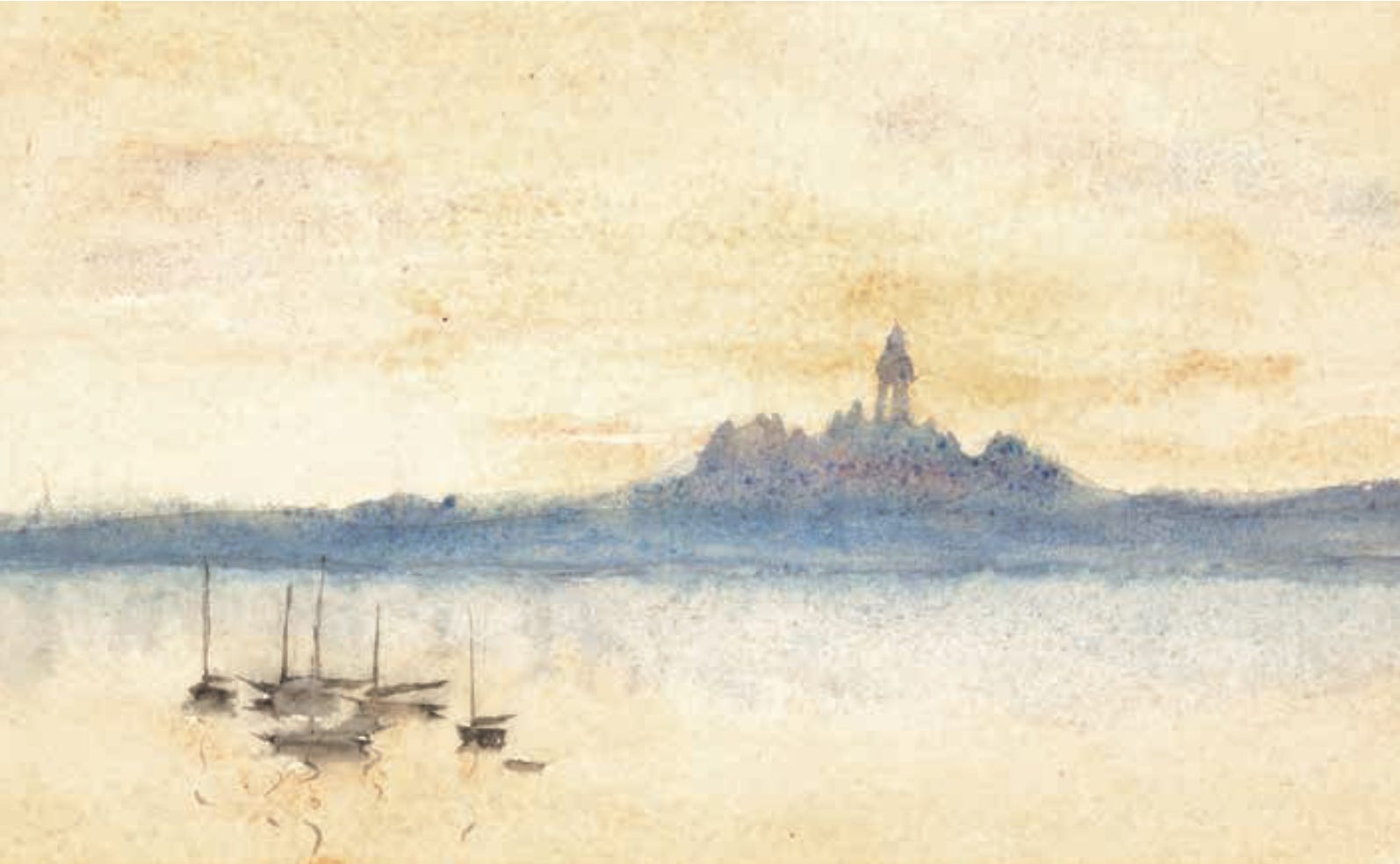
Arthur B. Carles (1882 - 1952) Harbor Scene, c. 1909, watercolor on paper 6 x 9 1/4 inches. Private collection, New York.
“If anything can rival Venice in its beauty, it must be its reflection at sunset in the Grand Canal.”
—Peggy Guggenheim1
In the fifth century, the Huns descended upon the Roman town of Aquileia, sending its refugees to the lagoon-wrapped islands of Venice. Over the next thousand years their descendants built a maritime empire, at its center the stilted, gondoliered city, “with iron hands and patient hearts, contending against the adversity of nature and the fury of man,” as the English critic John Ruskin put it in the mid-nineteenth century.2 Combining Byzantine and Gothic elements into its famously water-logged city, it retained its unique architecture through Napoleon’s liberation of the city in 1797. That Gothic character was little changed when Italy was unified into a modern state in 1866: Venice never had a Hausmann or a Robert Moses to bulldoze and modernize. The same security that made it a haven for the Aquileians also made it a haven from modernity.
By the time Ruskin was wheezing on about the iron hands and patient hearts that stirred the Grand Canal, he was writing about a backwater. In 1831, “the only Americans in Venice were Mr. Samuel Morse and myself,” wrote the painter Amasa Hewins, and if you’re thinking “Amasa Who-ins?” you’re on the right track: Americans were crawling over the old world in the mid-nineteenth century, taking over the Grand Tour that once inspired English collecting—but nobody who was anybody was in Venice. “Venice had no established art school, no sale galleries,” Margaretta Lovell observes, “and until late in the period, no contemporary art exhibitions.”
II. Warty bugs.
Anglophones in particular saw the city as primeval, its ancient stones closer to nature than to civilization. Herman Melville compared its Grand Canal that “winds like the Susquehanna” to geographic features instead of engineering marvels—odd oversight, because that’s exactly what it is. When Mark Twain called its domed skyline “a vast warty bug taking a meditative walk,”3 you can tell that this time-capsule quality was, for Americans at least, a bug.
For Ruskin, it was a feature. Ruskin was part of a wave that considered the Renaissance to be a massive misadventure—hadn’t Italians been better off, say, before Raphael?4 Arcane weirdness was really important to Ruskin, and he found it oozing from the stones of Venice; so much so that he published a three volume appreciation of its calcified weirdness, The Stones of Venice, in 1851.5 Ruskin’s philosophy was novel, but he was working in a field centuries old: the travel guide for the English aristocrat on the Grand Tour.6 After the dust settled on the English Civil War, the mark of a good country gentleman was to go rummage through the ruined villas of the Italian countryside for knickknacks of the top drawer. The English economy was on the rise but its cultural profile lagged sorely behind; Italy, just the reverse. A Roman statue; a frieze of Athenian marbles; a nice little portrait of a suffering saint—these could all be had cheaply, and they gave some much-needed gravitas to the English. Ruskin wrote at the tail end of this tradition—by the 1850s, the English aristocracy was following the lifecycle of their Italian forbears—becoming rich in culture but low on cash. But within that tradition, he was looking for something old and weird—and what’s older and weirder than Venice?
