
Gender Parity?
Why there have been so many great female artists.
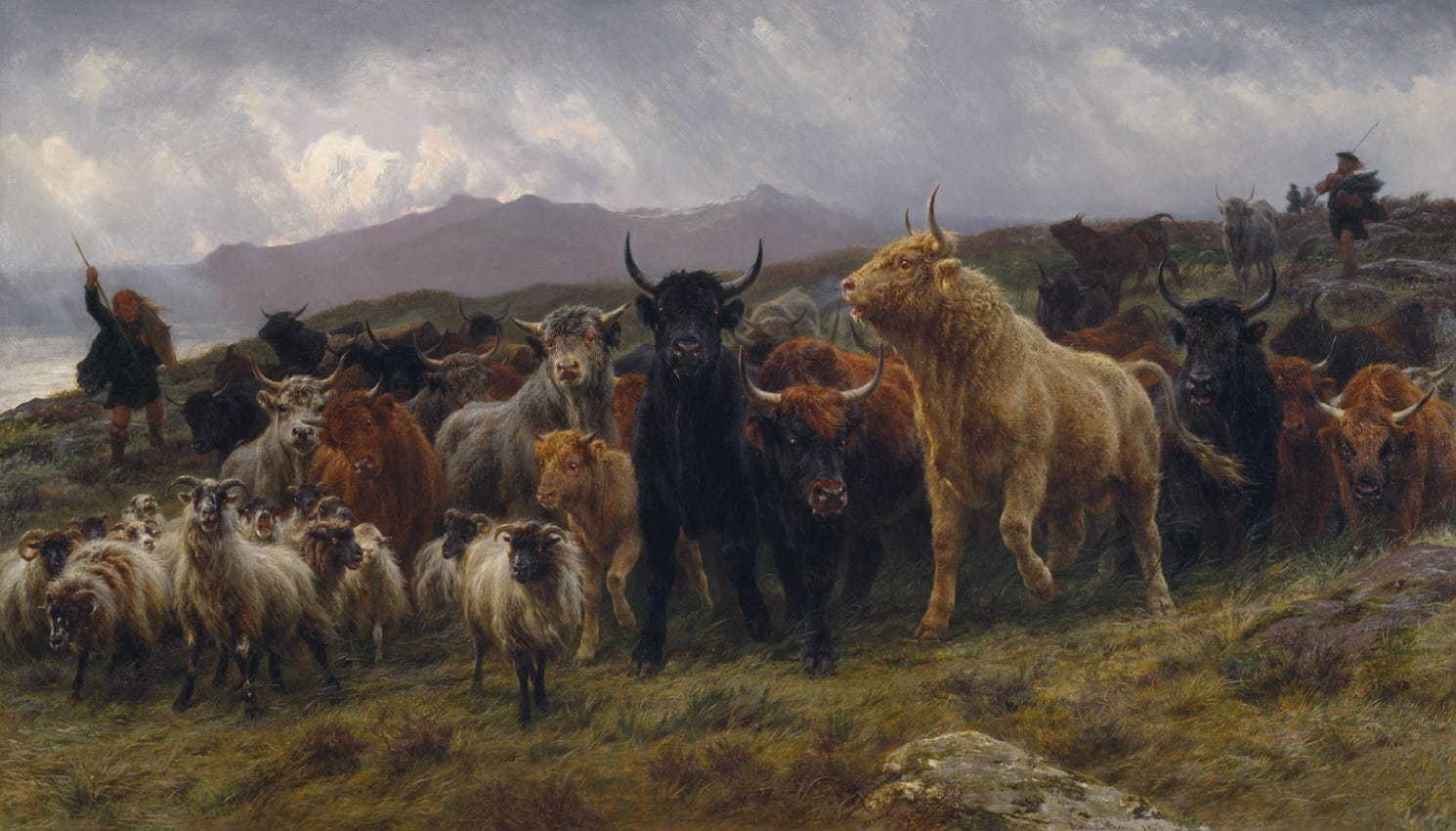
The Highland Raid, 1860: an unserious canvas by Rosa Bonheur?
“Ornamental education, or an attention to the graces, has a connexion with effeminacy. In acquiring the gentleman, I would not lose the spirit of a man.”
—Charles Butler, 1836
The artist Judy Chicago highlighted an interesting disjunct in her book Institutional Time: A Critique of Studio Art Education (2014): fine art has long been considered a feminine enterprise, while at the same time access to its professional practice has been closed to women. If art is for women, but women can’t study or practice professionally, what is for women?
A: Only unserious matters—hobbies and externalities to the fine art economy. Jonathan Conlin describes the weird rise of doily-making in the Settlement Houses of the early twentieth century in The Met: A History of a Museum and Its People (2024), and that has a parallel in the rise of watercolor and pastel as appropriate for women—hobbyist material—until male artists decided to take those things seriously themselves.
Interesting that nearly two centuries after Charles Butler’s helpful remarks about effeminacy of the arts, according to 2026’s Art Basel Art Market Report, a certain threshold has just now been crossed:
“Representation of female artists continued to strengthen in 2025, with primary market galleries reaching gender parity. Across all dealers, women accounted for 45% of artists represented (up 4% year-on-year and from 35% in 2018). Gains in commercial outcomes have been slower, but further progress was evident: female artists accounted for 37% of sales by value (up 2% year-on-year and from 28% in 2018), with improvements driven entirely by primary market galleries, where female artists generated 44% of sales.”1
That’s notable. Is it new?
Well, it’s hard to say. The patriarchy does a good job of obscuring the nature of these inquiries, as Katy Hessel’s The Story of Art Without Men (2022)2 and a few other recent books amply demonstrate.
But that headline number aligns with a purge: if women are more successful, they are also making less feminist art. That is, more successful women are making art with less of what Chicago calls “content.” The share of art sales by women has risen, and much of its rise is constituted by entirely abstract painting.
There are two edges here. AbEx is understood to be very “serious”—wrestling with the void, a bullfight of the soul, Hemingway on canvas, etc. So if women are to be taken seriously, they had to put down needle work and take up the most serious art of all. (The term “zombie formalism” was coined the same year as Chicago’s book.3)
Second, the abandonment of “content.” Chicago points to CalArts as a source of change in the way artists artists are credentialed, resulting “in a emphasis on skill training and little or no discussion about content, an approach that increasingly came to dominate university studio art education.”4 In other words, the studio art pedagogy embraced the view that content itself is unserious. The linkage of unserious content to unserious artists reaches fever pitch in Janson’s 1986 listing on Rosa Bonheur, which understands the great woman painter’s work “appeals to conservative taste that generally prefers pretentious history painting.”5 Possibly true, but it’s a critique that isn’t leveled at, say, Emanuel Leutze—a pretentious history painter for conservative tastes if ever there were one.
What am I saying—that AbEx can’t be feminist? Isn’t it a feminist assertion to be able to just exist, survive, and to succeed at parity with men—isn’t that feminist? Maybe we should take a critical look at the dismissive descriptor “zombie formalism” and see a tool of patriarchy to create a new glass ceiling on women artists?
To take Chicago’s cue, there is some relevant history here. When women in the pre-modern, pre-Feminist era succeeded, they did so as the exception—they received private instruction, mostly by their fathers, and gained access through literally patriarchal corridors of power. But these were begrudged exceptions that proved the rule. It was a one-off, and the artworld has admitted one-offs for a long time—as long as the general structure remains intact.
Chicago’s sense of female empowerment cuts a different way: the idea of stepping up and bringing everyone.6 Imperfectly enacted and at glacial speed, but I think that’s why you see things tipping in 2026 rather than 1826: one woman walking through the door in the form of Rosa Bonheur was tolerated, but the institutional change Feminism requires has taken infiltration of every tier of the artworld gatekeeping system. It has required institutional change—and that means not just one-off luminaries, “geniuses” in the Leonardo model, but organization.
The market report follows up the good news with the bad: while the low end of the market has reached parity by some measures, the top end has not. The myths of feminine un-seriousness and the effeminacy of the fine arts has been roundly rebutted, in theory and fact—but the biggest prizes are still to be won.
Thanks for reading,
Jonathan
Jonathan@JonathanMillerSpies.com
The Art Basel and UBS Art Market Report 2026 by Arts Economics, p. 44, full text here.
Read our gloss on Hessel’s book here.
Read our defense of “zombie formalism” here.
Judy Chicago, Institutional Time: A Critique of Studio Art Education (2014), p. 80.
As quoted by Chicago, p. 106.
Everyone? That needs a bit of interrogation, but save that for another post.
Thanks for reading! I didn't know Shoshannah White but it's cool! I love the materiality of the ice pictures. Disembodied and grounded at the same time. Cool!
I definitely enjoyed this post. I had lost track of your blog until we were having dinner with your mother and Wayne tonight. Glad I read this. BTW do you know Shoshannah White’s work?